Medical & Allied Health Clinic Cleaning in Melbourne
Healthcare cleaning designed around your practice
A medical practice is not an office with different furniture. Consulting rooms, waiting areas and amenities each carry a different level of risk, and cleaning them properly means treating them differently — with a defined scope, the right equipment in the right room, and a record of what was done.
OXTON provides recurring cleaning for GP clinics, medical centres and allied health practices across Melbourne's CBD, inner west, western corridor and north-west corridor. We are owner-led, which means the person who sets the standard is the person accountable for it.
Our cleaning processes are built on infection prevention and control training and set out in our own written procedures — covering how areas are classified by risk, how equipment is separated between zones, and how every visit is recorded.
Infection Prevention Systems
Cleaning is built around colour-coded equipment, dedicated zones and written procedures designed for clinical environments.
High-Touch Point Disinfection
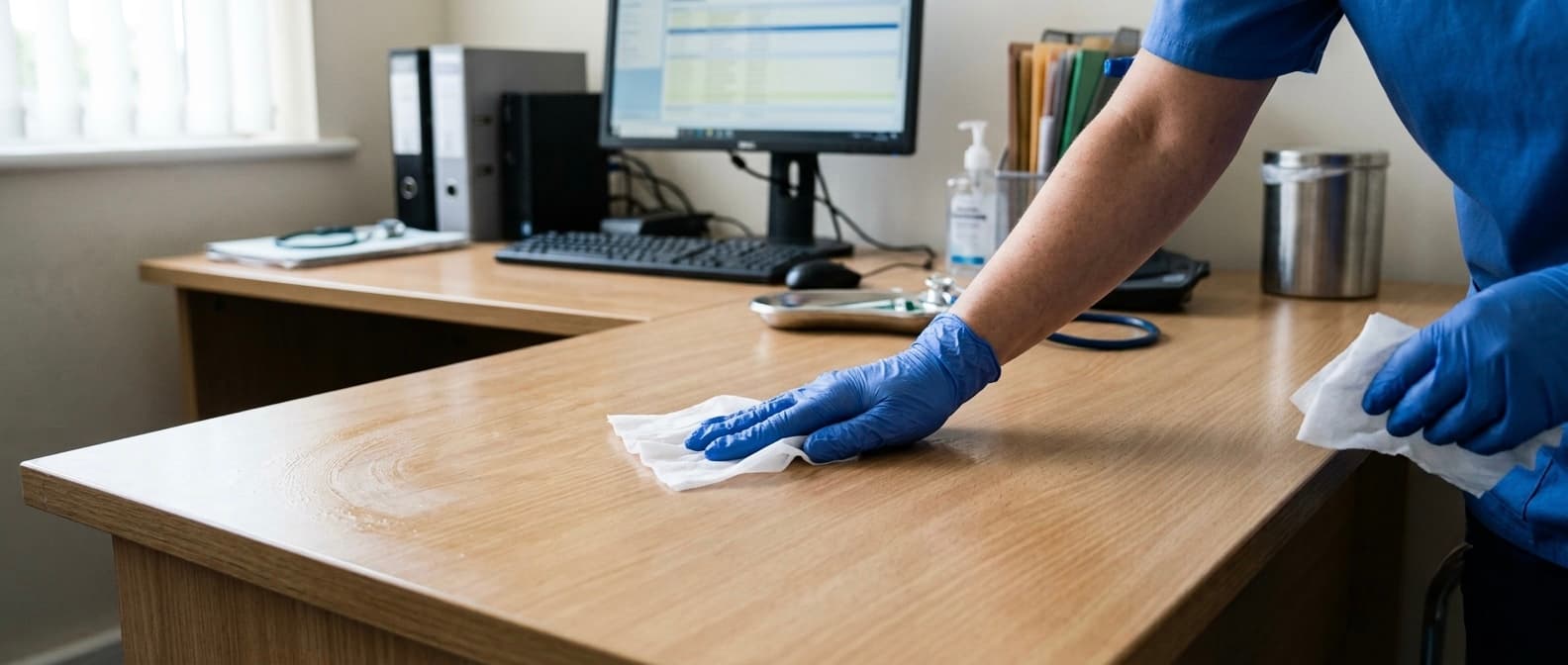
Door handles, light switches, taps and reception counters are disinfected on every scheduled visit. In consulting and treatment rooms, disinfection follows the agreed cleaning procedure for that room, including the required contact time.
Documented Every Visit
Every service is recorded, giving your practice a dated cleaning history to support its own quality and accreditation records.
Confidentiality & Privacy
Police-checked, with confidentiality obligations that continue after any service agreement ends.
Fully Insured
$20 million public liability cover. Certificate of Currency available on request.
Who we clean for
We focus on healthcare and allied health environments rather than offering a broad range of unrelated services. That focus is deliberate — it lets us build procedures around the way these practices actually operate.
- GP clinics and general practice
- Medical centres and multi-practice sites
- Physiotherapy and exercise physiology
- Psychology and counselling practices
- Podiatry
- Occupational therapy
- Speech pathology
- Dietetics
- Specialist medical consulting suites
If your practice type isn't listed, it's still worth asking — what matters is the clinical risk profile of the site rather than the discipline.
What we clean, area by area
Each site is covered by a written Site Cleaning Scope of Works: one document recording exactly which areas are cleaned, how often, and to what standard. It forms part of your service agreement, and it is the document your clean is measured against.
A clinic scope covers areas such as:
Reception and waiting areas
Floors vacuumed or mopped, counters wiped, bins emptied, and high-touch surfaces disinfected — including chair arms, door handles and the shared surfaces patients contact most.
Consulting and treatment rooms
Cleaned according to the clinical use and risk profile of the room. Frequently touched and relevant patient-contact surfaces are cleaned and, where required by the agreed cleaning procedure, disinfected. Floors are cleaned and general waste is emptied.
Bathrooms and amenities
Toilets, basins, mirrors and floors cleaned and disinfected, using equipment reserved for this zone alone.
Staff kitchen and breakroom
Benches, sinks and splashbacks wiped down and bins emptied, again with its own dedicated equipment.
Corridors and common areas
Floors cleaned, ledges dusted, and handrails and door handles disinfected.
Where a practice has a procedure or minor-operations room, the frequency and any additional disinfection are set by the practice and recorded in the scope — not assumed by us.
How infection prevention works in practice
Areas are classified by risk, not treated identically
Not every room in a clinic carries the same risk, so not every room is cleaned the same way. Reception, offices and corridors are cleaned to a general standard with high-touch points disinfected. Bathrooms, kitchens, and treatment room floors and fixed surfaces are cleaned and then disinfected. Consulting and treatment rooms — and any room your practice flags as higher risk — have high-touch and relevant patient-contact surfaces cleaned and, where the agreed cleaning procedure requires it, disinfected, using equipment allocated to that zone and appropriate protective equipment.
Colour-coded equipment helps keep cleaning zones separate
Cleaning equipment is assigned to designated areas and is not used across different zones, helping reduce the risk of cross-contamination.
Clean first, then disinfect — and allow the contact time
Disinfectant applied over visible soil does not work properly, so surfaces are cleaned with detergent first. We work from clean areas to dirty, and from high surfaces to low. Disinfectant is applied in accordance with the manufacturer's instructions, including the required contact time. Where disinfection is required, OXTON uses ARTG-listed disinfectants appropriate for their intended healthcare use.
What's included — and what isn't
Clear boundaries are part of a professional service. They mean nothing is assumed and nothing important is left to chance.
What we do
- Clean and disinfect the areas set out in your Scope of Works, to the standard it records
- Disinfect high-touch points on every visit
- Empty and re-line general waste bins
- Report anything we find that needs your attention
What we don't do
- Handle sharps. Not under any circumstances. If we find one outside its container, we stop, leave it, and tell you.
- Handle clinical waste bins. We check them visually and report anything open, overflowing or damaged — we don't move, empty or replace them.
- Reprocess or sterilise clinical instruments. That remains with your clinical staff.
- Advise on clinical, accreditation, infection prevention or waste-management matters. Responsibility for clinical governance, regulatory compliance and accreditation stays with your practice.
If we encounter a spill we aren't equipped to manage safely, or an area you've flagged as an isolation or infection alert, we stop and contact you rather than proceeding.
Documentation your practice can use
Accreditation reviews look at the systems behind a practice's clinical environment, and cleaning is one of them. OXTON's documentation is designed to fit alongside your own records rather than sit separately from them.
- A completion record for every visit — areas serviced, tasks completed, time on site and anything noted, giving you a dated service history rather than an assurance that the work happened.
- A written scope for your site, recording what is cleaned, how often and to what standard, forming part of your service agreement.
- Incident and corrective action records where required, actioned and closed out in writing.
- A chemical register and Safety Data Sheets for the products used at your site, available for review on request.
- Written cleaning and infection control procedures, available to your practice manager, or to an accreditation auditor, on request.
This documentation supports your practice's own systems and record-keeping. It doesn't replace them, and it doesn't guarantee an accreditation outcome.
For more on where cleaning sits in the RACGP Standards for general practices — and what the criterion does and doesn't require — see clinic cleaning documentation.
How recurring cleaning works
A schedule built around your practice
Cleaning frequency is agreed according to your site, your scope and how your practice operates, rather than set to a standard template. Additional or one-off cleans can be arranged outside the regular schedule, subject to availability.
After-hours servicing
Clinic cleaning is normally scheduled outside consulting hours, so patients, practitioners and reception staff are left undisturbed. Servicing times are agreed with your practice and recorded in your schedule.
Access, security and confidentiality
Keys, alarm codes and access arrangements are documented and handled confidentially. Site-specific requirements — restricted areas, rooms needing supervised access, anything out of bounds — are recorded in your scope so they're followed every visit rather than remembered on the night. Patient information encountered during a service is not accessed, read, photographed, copied or discussed, and that obligation continues after any service agreement ends.
Consistency and communication
Wherever possible the same cleaner services your site, so your practice isn't re-explaining its requirements. Because OXTON is owner-led, you deal directly with the person accountable for the standard. If something is missed, tell us — issues are recorded, actioned and closed out in writing rather than handled informally.
Melbourne areas we service
OXTON's service area covers Melbourne's CBD and inner city, the inner west, the western corridor and the north-west corridor — around 60 suburbs, including Footscray, Yarraville, Moonee Ponds, Essendon, Sunshine, Point Cook and Werribee.
If you're unsure whether your practice falls inside our service area, check the full suburb list or get in touch.
Common questions from practice managers
Do you clean around patient appointments, or after hours?
Clinic cleaning is normally scheduled outside consulting hours so patients and practitioners aren't disrupted. Servicing times are agreed with your practice and recorded in your cleaning schedule.
Do you handle clinical waste or sharps?
No. Sharps are never handled by OXTON under any circumstances. Clinical waste bins are checked visually and reported if open, overflowing or damaged, but they aren't moved, emptied or replaced. Both remain the responsibility of your practice and its licensed clinical waste provider. General waste is emptied and re-lined as part of every service.
Can you provide cleaning records for our accreditation?
Yes. A completion record is produced for every visit, your site has a written Scope of Works, and corrective actions are documented where required. Our written cleaning and infection control procedures can also be provided to your practice manager or an accreditation auditor on request. These records support your practice's own systems — responsibility for accreditation remains with your practice.
Can we have the same cleaner for each visit?
Wherever possible, yes. Continuity matters in a clinic: it means the person cleaning already knows your layout, your restricted areas and your requirements.
What happens if something is missed?
Tell us. Issues are recorded and actioned rather than handled informally. Where corrective action is required, the issue and action taken are documented and followed through to completion.
More questions? See our full FAQ.
Request a quote
Wherever possible, a quote starts with a site walkthrough. We look at your practice, discuss how it operates and what it needs, then provide a written proposal setting out the recommended scope, schedule and pricing. Site inspections and quotes are free and carry no obligation.